What Are the 2026 Top Solar Street Lights Outdoor Types?

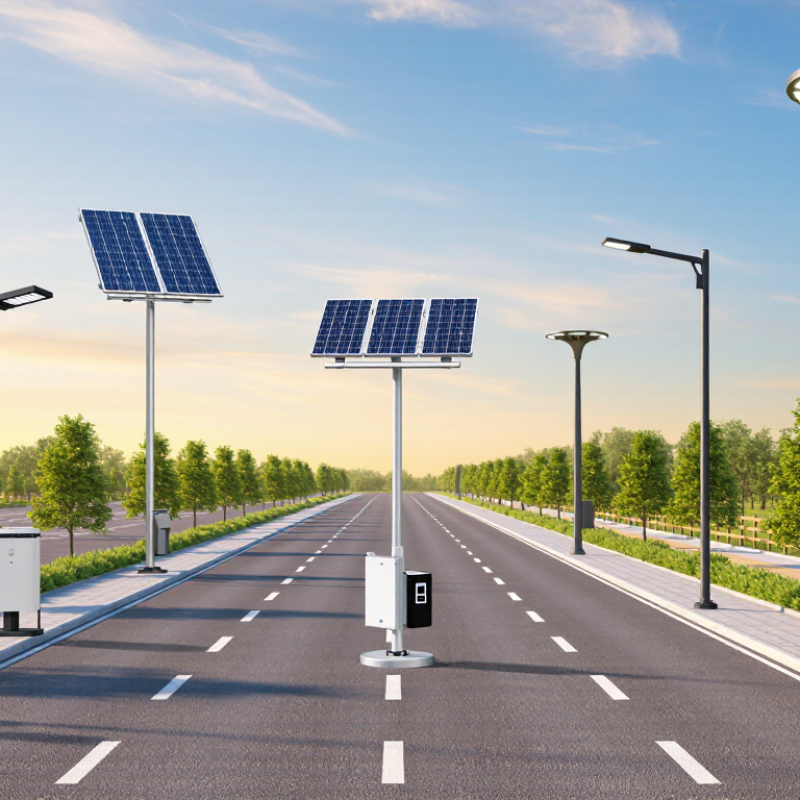
Choosing the right Solar Street Lights Outdoor system in 2026 requires more than comparing brightness or panel size. Municipal roads, parking areas, pathways, and rural entrances face different lighting demands. A compact all-in-one lamp may suit a pedestrian path, while a split-type system can perform better where larger panels and batteries are needed. Hybrid solar and grid-assisted models may also support locations with long cloudy periods.

Fatih Birol, Executive Director of the International Energy Agency, said, “Solar is the new king of electricity markets.” His observation helps explain why solar lighting continues gaining attention. However, a street light is not simply a small solar power plant. It must manage night-long illumination, battery aging, wind exposure, rain, dust, and seasonal sunlight changes.

This guide examines the leading outdoor types expected in 2026. It considers all-in-one, split, hybrid, smart-controlled, and high-mast designs. Important details include LED efficiency, battery chemistry, panel orientation, IP and IK ratings, motion sensing, and autonomy days. A brighter fixture is not always the better choice. Sometimes, better control matters more.

Real conditions can be untidy.

A product rated for strong sunlight may struggle during winter storms. A low-cost battery may reduce the initial budget, yet increase replacement work later. Even experienced buyers can overlook maintenance access and local installation practices. These limitations deserve honest attention. The following overview compares practical strengths, likely weaknesses, and suitable applications for each major Solar Street Lights Outdoor type.
What Are the 2026 Top Solar Street Lights Outdoor Types?

All-in-One Solar Street Lights: 150–180 lm/W LED Efficiency

What Are the 2026 Top Solar Street Lights Outdoor Types?

All-in-one solar street lights are gaining attention in 2026 because they simplify outdoor lighting projects. Their LED modules can deliver 150–180 lm/W under suitable operating conditions. This efficiency produces brighter roads while using less stored energy. The panel, battery, controller, and lamp share one compact housing. Installation is faster, with fewer exposed cables and connection points. In residential lanes, parking areas, and rural roads, this design can reduce maintenance visits. However, the highest laboratory rating should not be treated as a guaranteed nighttime result. Real performance changes with temperature, dust, shading, and battery age.

Tips: Check the working lumen output, not only the LED efficiency. Review the battery capacity and expected autonomy for cloudy nights. A motion-sensing dimming mode can preserve energy near quiet paths. Keep the solar panel clear of branches and seasonal shadows. Small details matter.

From practical evaluations, correct sizing is more important than choosing the brightest fixture. A 180 lm/W light may still perform poorly if its panel is undersized. Battery chemistry, charge control, mounting height, and road width all affect useful illumination. I would also inspect the beam pattern before purchase, because excessive glare can reduce visual comfort. Some specifications appear impressive, yet field results can be less consistent. That is a reason to request test data, installation guidance, and realistic warranty terms before deployment.

Split-Type Solar Street Lights: 8–12 Hours of Nightly Illumination

Split-type solar street lights place the photovoltaic panel, battery, controller, and LED fixture in separate positions. That separation matters. Panels can face better sunlight, while fixtures remain above roads, paths, or parking areas.

With correct sizing, these systems commonly provide 8–12 hours of nightly illumination. The IEA PVPS Trends in Photovoltaic Applications 2024 report recorded about 456 GW of new solar capacity worldwide in 2023. This rapid expansion supports more efficient panels and better energy-management components for outdoor lighting. However, solar capacity growth does not guarantee reliable street lighting.

A practical design should match local sunlight, traffic patterns, and battery temperature. A 100-watt LED running for ten hours needs roughly 1,000 watt-hours before system losses. Cloud cover, dust, and winter conditions require additional reserve. On a narrow road, careful placement also prevents tree shadows from cutting morning charging.

The 8–12-hour promise is not automatic. Field commissioning often exposes undersized batteries or poorly angled panels. That is an uncomfortable detail, but an important one. GOGLA’s Global Off-Grid Solar Market Report for the first half of 2024 recorded 9.3 million off-grid solar products sold globally, showing strong market activity. Yet maintenance still decides long-term performance. Technicians should inspect battery health, cable seals, panel cleanliness, and dimming schedules every season. A split design makes those checks easier, though it adds more wiring and installation points.

What Are the 2026 Top Solar Street Lights Outdoor Types? - Split-Type Solar Street Lights: 8–12 Hours of Nightly Illumination

Evaluation Dimension Typical Specification or Result Practical Outdoor Value
System Configuration Separate solar panel, LED luminaire, battery, and controller Allows each component to be sized, positioned, replaced, or serviced independently.
Nightly Illumination Approximately 8–12 hours per night, depending on the programmed lighting profile and stored energy Supports dusk-to-dawn operation for roads, pathways, parking areas, and public spaces.
Solar Panel Rating Commonly about 80–200 Wp for many outdoor installations; final sizing depends on load, location, and solar resource The separate panel can be tilted and oriented to improve daily solar collection.
LED Power Range Typically about 20–80 W for pedestrian areas, residential streets, access roads, and small parking zones Enables the system to be matched to roadway width, mounting height, and required illuminance.
LED Efficacy Approximately 120–180 lm/W for modern outdoor LED luminaires Higher efficacy produces more light from the same electrical energy, helping reduce battery and panel requirements.
Battery Technology Lithium iron phosphate batteries are commonly selected for outdoor solar lighting; sealed lead-acid batteries are another option Battery selection affects usable capacity, temperature performance, service life, enclosure size, and total cost.
Battery Autonomy Usually designed for approximately 2–5 nights without sufficient sunlight Provides operating reserve during cloudy or rainy periods; the required reserve varies by climate and project standard.
Lighting Control Photocell or programmable controller with dusk activation, timed dimming, and dawn shutoff Dimming can reduce energy consumption during low-traffic hours while maintaining basic visibility.
Typical Dimming Profile Full output during active hours, followed by approximately 30–70% output during selected late-night periods Balances visibility, battery reserve, and lighting energy use.
Mounting Height Approximately 4–10 m, depending on road classification, pole spacing, and photometric requirements Higher mounting can increase coverage, but it may require greater LED output and stronger structural design.
Recommended Installation Areas Residential streets, pedestrian paths, parks, campuses, parking lots, rural roads, and remote access routes Particularly useful where trenching or grid-connection work is expensive, disruptive, or unavailable.
Ingress Protection Outdoor luminaires and enclosures are commonly specified at IP65 or higher Helps protect against dust and water jets; the exact rating should be verified for each component.
Operating Temperature A typical outdoor design target is approximately −20°C to 50°C, subject to component specifications Climate-compatible batteries, controllers, and thermal management are important for reliable operation.
Expected LED Service Life Often rated around 50,000–100,000 operating hours, subject to thermal conditions and product testing LEDs generally require less frequent replacement than conventional discharge lamps.
Maintenance Requirements Periodic cleaning of the panel and luminaire, inspection of wiring and fasteners, and eventual battery replacement Routine inspection helps maintain solar charging, optical performance, and structural safety.
Main Design Considerations Solar irradiation, seasonal weather, shading, pole spacing, lighting standards, wind load, battery reserve, and security A site-specific design is essential; nominal wattage or panel size alone cannot guarantee 8–12 hours of nightly illumination.

Note: The values shown are typical planning ranges for split-type solar street-light systems. Final specifications should be confirmed through site surveys, photometric calculations, local codes, and seasonal solar-resource data.

Smart Solar Street Lights: LoRaWAN, 4G Control, and Adaptive Dimming

Smart solar street lights are becoming a practical choice for roads, parks, campuses, and remote public spaces. Their value extends beyond solar charging. LoRaWAN enables low-power communication across widely distributed lamps, while 4G control supports faster data transfer and remote firmware management. In field projects, this difference matters. LoRaWAN often suits large areas with modest data needs. 4G is more suitable when operators require frequent status updates, camera integration, or detailed energy reports.

Adaptive dimming makes the system more responsive after dark. A lamp can operate at lower brightness during quiet hours, then increase output when motion sensors detect pedestrians or vehicles. This reduces battery stress and preserves useful light before sunrise. However, sensor settings need careful commissioning. Excessive sensitivity may trigger unnecessary brightness changes, while weak detection can create uncomfortable dark patches. Small details matter, including pole spacing, tree movement, road dust, and winter temperatures.

Reliable deployment requires more than selecting a communication method. Technicians should record battery voltage, charging current, light output, and network strength during several weather conditions. I have seen systems perform well in summer but struggle after cloudy weeks. That result challenged our original assumptions. Backup schedules and local fault alerts remain valuable when cellular coverage drops or gateways fail. Remote control is powerful, but it is not magic. Human inspection still catches tilted panels, damaged sensors, and water entering cable joints.

2026 Top Solar Street Light Types by Smart Function Coverage

The chart compares commonly available functions in four outdoor solar street light configurations. Basic systems provide automatic dusk-to-dawn operation, while LoRaWAN and 4G systems add remote monitoring, scheduled dimming, fault alerts, and group control. Adaptive-dimming models adjust lighting output according to traffic, motion, or preset operating conditions. The values represent the number of listed functions, not market share or product performance.

Hybrid Solar Street Lights: Grid Backup for 95%+ Lighting Availability

What Are the 2026 Top Solar Street Lights Outdoor Types?

Hybrid Solar Street Lights: Grid Backup for 95%+ Lighting Availability

Hybrid solar street lights are among the most practical outdoor lighting types for 2026. They combine a photovoltaic panel, battery, efficient LED fixture, and grid connection. During sunny hours, the panel charges the battery. At night, stored energy powers the lamp. If several cloudy nights reduce battery capacity, the controller draws electricity from the grid. This backup can support 95% or higher lighting availability when the system is correctly designed.

That figure is not automatic. Engineers should review solar radiation, winter temperatures, pole spacing, traffic patterns, and required lighting hours. A 30-watt fixture may suit a quiet lane, while a wider road needs different optics and higher output. Battery reserve should cover local weather risks, not only average conditions. In practice, dust on panels, partial shade, loose terminals, and aging batteries often cause avoidable outages. Small details matter.

Good projects also use remote status monitoring and scheduled inspections. Technicians can check battery voltage, charging current, grid transfer events, and nighttime brightness. The hybrid design costs more than a basic off-grid unit, but it reduces the risk of dark streets. It also avoids oversized batteries in locations with unreliable sunlight. Still, grid dependence weakens energy independence, and tariffs can change. The 95%+ target should be verified through operating data, not promised in a brochure. That is the part many plans miss.

2026 Selection Criteria: IP66, IK08, LiFePO₄, and 3–5-Day Autonomy

What Are the 2026 Top Solar Street Lights Outdoor Types?

In 2026, the strongest outdoor choices are integrated all-in-one, split-type, and adaptive solar street lights. Each type needs more than a bright lumen claim. The IEA PVPS Trends in Photovoltaic Applications 2024 report recorded 456 GW of new global photovoltaic capacity in 2023. This scale makes component quality increasingly important. For coastal roads, choose IP66 protection, which resists dust and powerful water jets under IEC 60529. IK08 protection adds resistance to impacts up to 5 joules under IEC 62262. That matters near schools, parking areas, and exposed walkways.

LiFePO₄ batteries suit projects requiring safer thermal behavior and repeated daily cycling. However, advertised cycle numbers can mislead. Check the test temperature, discharge depth, and remaining capacity. The Global Off-Grid Solar Market Report 2024 highlights continuing growth in decentralized solar use, but field performance still depends on sizing and maintenance. A three-day autonomy system may fail during a long cloudy spell. Five days offers more resilience, especially in winter or rainy regions. Battery capacity should reflect actual lamp power, dimming schedules, and local solar irradiation.

A practical design uses motion dimming after midnight. It reduces energy waste without leaving paths dark. Keep the panel clear of branches and dust. Small details matter. I would not treat IP66 as waterproof forever. Seals age, screws loosen, and poor installation creates hidden failures. Select products with documented photometric tests, battery data, and at least twelve months of operating evidence from comparable climates. Test samples on-site before large deployment. Metrics often look cleaner than reality.

Go to Top