
Why Choose Track Light Fixtures for Your Business?

Track Light Fixtures give businesses a practical way to direct light where work and customer attention need it. A narrow beam can highlight a product shelf, while a wider beam can brighten a checkout counter or meeting table. In a café, adjustable heads can shift attention from the service area to evening displays. In a shop, they can make new merchandise easier to notice without changing the entire ceiling.

Lighting designer Richard Kelly is known for describing lighting through ambient luminescence, focal glow, and play of brilliants. A useful paraphrase of his approach is: “Light should guide attention, not simply brighten a room.” That distinction matters. Brightness alone does not guarantee comfort or clarity. Glare on a glossy counter, uneven shadows, or an unsuitable beam angle can make a carefully planned space feel tiring. Small details count.

This introduction explores why businesses choose Track Light Fixtures, including their adaptability, focused illumination, and potential to support different tasks. It also considers practical decisions, such as fixture placement, beam spread, color appearance, dimming compatibility, and maintenance access. These choices depend on the room, its ceiling, and how people use it each day. Track lighting is not a cure-all. Poor planning can leave dark patches or put light in the wrong place. That part is easy to underestimate. A thoughtful design starts with the actual space, then tests the result before treating the layout as finished.
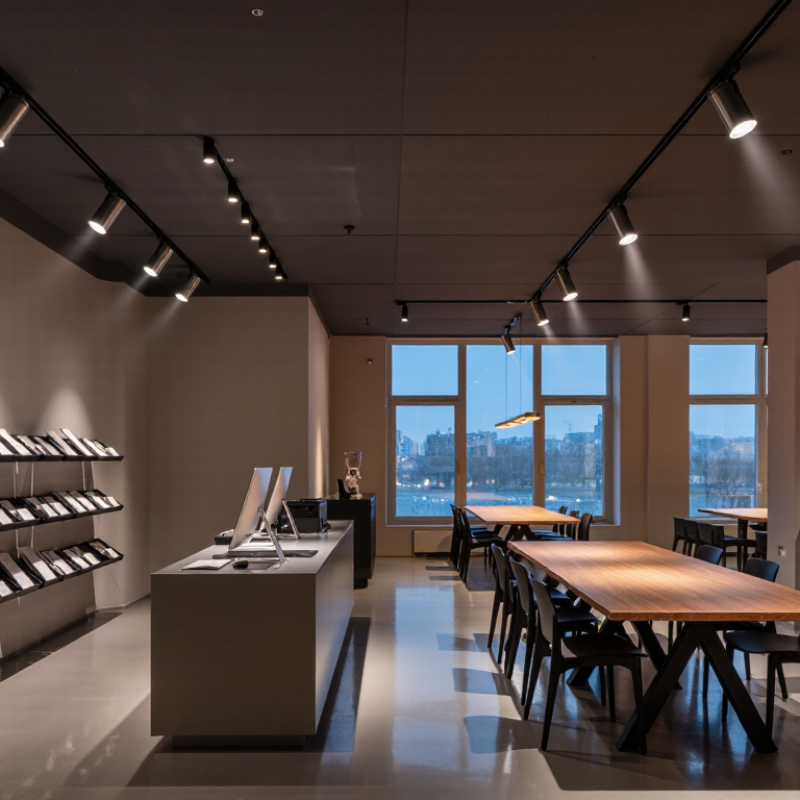
Why Choose Track Light Fixtures for Your Business?

What Track Light Fixtures Are and How They Work

Track light fixtures are adjustable luminaires mounted on an energized rail. The rail supplies power, while each fixture head attaches through an adapter. Many heads slide along the track and pivot, letting staff aim light at shelves, counters, artwork, or work areas. Some systems use line voltage; others use low voltage and a transformer. Compatibility matters: track shapes and electrical connections are not always interchangeable.

Inside each head, a lamp or LED module produces light, and a reflector or lens directs its beam. Narrow beams can highlight a display; wider beams can soften shadows across a counter. Dimming depends on the fixture, lamp, and control system working together. It sounds simple, but mismatched parts can cause flicker or prevent installation. The U.S. Energy Information Administration’s 2018 Commercial Buildings Energy Consumption Survey identifies lighting as about 17% of electricity use in commercial buildings, making efficient choices worth considering.

Tip: Before choosing fixtures, check the track type, ceiling height, beam angle, and dimmer compatibility. Test one head on the actual surface. White walls may reflect more light than dark shelving, so a showroom sample can mislead. A quick measurement helps, though it may not capture every real-world shadow.

Key Advantages for Commercial Spaces

Track light fixtures give commercial spaces flexibility when displays, furniture, or work areas change. Adjustable heads can illuminate a checkout counter, a textured wall, or a product shelf without relocating ceiling wiring. That can make small layout updates simpler. Less disruption. Businesses can also choose different beam angles and light levels to suit specific tasks, provided the fixtures and lamps are compatible.

For retail shops, focused lighting can help products stand out while keeping aisles comfortably visible. In galleries, it can draw attention to selected pieces; in studios, it can brighten work surfaces. A practical benefit is that individual heads can be repositioned as needs shift. Still, track lighting is not a fix for every room. Poor aiming may create glare on glass, harsh shadows, or dim corners. Ceiling height, track placement, and the room’s overall light should be assessed before installation.

Tips: Test the proposed layout after dark, when daylight is not masking uneven areas. Aim lights slightly off reflective surfaces to limit glare. Keep a simple plan of track positions and beam directions; it may need revision once shelves or displays are in place.

How to Match Track Lighting to Business Needs

Matching track lighting starts with what staff and customers need to see. In a clothing shop, adjustable heads can reveal fabric texture without flooding every aisle. For color-sensitive displays, consider light sources with a CRI of 90 or higher, then test them beside actual merchandise. Small differences matter. A warm tone may suit a café, while neutral white can keep office work areas feeling clear.

Map tasks before choosing fixtures. Narrow beams can highlight shelves, artwork, or a checkout counter; wider beams provide more even general light. Measure ceiling height and fixture spacing, then check for glare on screens and polished surfaces. A mock-up helps. Track lighting is useful when displays change, but too many heads can create bright spots and uneven shadows. It is easy to overdo.

Match light output and controls to operating hours. Dimming or separate switches let staff adjust displays after closing or provide useful task light during cleaning. Check the track’s load rating, compatibility, and mounting surface; a qualified lighting professional or electrician can verify the plan, especially in older spaces. Floor-level tests may catch issues that drawings miss. Still, daylight shifts, and a test at noon may not represent winter evenings. Consider adjusting the aim after staff have used the space for a week.

Why Choose Track Light Fixtures for Your Business? — How to Match Track Lighting to Business Needs

Business Area Lighting Priority Suggested Track Head Typical Beam Angle Suggested Color Temperature Color Rendering (CRI) Practical Consideration
Retail product displays Highlight merchandise and create visual contrast Adjustable LED spotlight, approximately 10–25 W per head 15°–30° for focused accents; 35°–60° for broader displays 3000–3500 K for warm materials; 3500–4000 K for a neutral appearance 90 or higher for color-sensitive merchandise Aim at products rather than customers’ eyes, and check that beam overlap avoids harsh bright spots.
Art galleries and showrooms Accurate color presentation with controlled emphasis Dimmable LED spotlight with an adjustable head 15°–35°, selected to suit the artwork or display size 3000–3500 K, subject to the displayed materials and desired appearance 90 or higher; verify color quality for critical artwork Use compatible dimming and consider low-UV, low-heat sources for sensitive objects.
Restaurants and cafés Comfortable ambience with clear visibility on tables and counters Dimmable spotlight or floodlight, approximately 8–20 W per head 25°–60° depending on table size and ceiling height 2700–3000 K for a warm atmosphere 80 minimum; 90 or higher where food appearance is especially important Provide even light on dining surfaces and use dimming to adapt to different service periods.
Offices and meeting rooms Balanced task lighting with reduced glare Wide-beam track head or linear track fixture 50°–90° or a broad distribution 3500–4000 K for a neutral work environment 80 minimum Plan for uniform coverage and screen comfort; track lighting may supplement, rather than replace, general lighting.
Reception areas and hotel lobbies Welcoming appearance and flexible accent lighting Mix of adjustable spotlights and wider-beam heads 25°–60° 2700–3500 K, coordinated with interior finishes 80 minimum; 90 or higher for prominent finishes or displays Use separate switching or dimming zones for feature walls, reception desks, and circulation areas.
Small shops and changing layouts Easy repositioning as fixtures, displays, or merchandise move Compatible adjustable LED heads on an appropriately rated track system Choose a mix of approximately 24°–60° 3000–4000 K to suit the product and store atmosphere 80 minimum; 90 or higher for apparel, cosmetics, and other color-sensitive products Confirm track type, electrical load, and connector compatibility before adding or moving heads.

Planning note: These are starting points, not a substitute for a lighting calculation. Final selection depends on ceiling height, surface reflectance, fixture output, spacing, local codes, and the required illuminance for the task.

Installation, Controls, and Energy Efficiency

Track lighting can make changing retail displays or work areas easier, but a good result starts before fixtures go up. Measure the ceiling, note beams and shelving, and map where people need clear, even light. A short mock-up helps. In a small shop, shifting one head by half a metre can reduce glare on a glass counter. Plan the track around actual tasks, not just ceiling lines.

Installation depends on the ceiling structure, circuit capacity, and chosen track system. Confirm the track is securely supported and the circuit can handle the planned load. Have a qualified electrician check wiring and connections, especially when replacing older fittings. Controls need attention too. Dimmers, occupancy sensors, and daylight sensors must match the fixtures and drivers. Incompatible parts may flicker or dim unevenly. Test controls at different times, not only during a bright afternoon.

Energy savings come from the whole setup, not from track alone. Efficient LED heads, careful aiming, and sensible switching can reduce wasted light. Aim beams at shelves or desks instead of blank walls, and use separate control zones for display and general lighting. Track heads are easy to reposition as layouts change. Still, too many heads can increase energy use and create hot spots. A first layout may miss something; real use often reveals what needs adjusting.

Why Choose Track Light Fixtures for Your Business?

Illustrative annual electricity use for 10 track heads operating 8 hours per day, 300 days per year.

Example calculation: At 50 W per halogen head versus 10 W per LED head, the same 10-head setup uses 1,200 kWh versus 240 kWh annually—an 80% reduction in this scenario. Actual wattage and savings vary by fixture and use. Track systems can simplify aiming and rearranging lights; dimming and occupancy controls can further reduce energy use when lights are not needed at full output.

Maintenance and Long-Term Operating Costs

Track lighting can make routine maintenance easier because each head can be adjusted or replaced without changing the entire layout. In a shop, staff may need to redirect light toward a new display. That takes minutes, not a ceiling redesign. Still, easy access depends on track height and fitting compatibility. A high ceiling or discontinued component can turn a simple repair into a service call.

Long-term costs include more than the fixture price. Dust on lenses and reflectors can reduce brightness, so include gentle cleaning in regular maintenance. Check for loose connections, flickering, and heat damage, and follow the fixture maker’s care instructions. With LED systems, lower energy use and fewer lamp changes may help control costs, but drivers and control components can still fail. It is easy to overestimate the savings before checking local electricity rates, operating hours, and replacement-part availability. Small details matter.

Tips: Keep a record of fixture types, lamp or module specifications, and installation dates. Clean fixtures with power switched off, using a dry or lightly damp cloth. Test dimmers with the intended lamps before fitting many heads. A small compatibility issue can become an expensive repeat visit.

Go to Top