Top Solar Pole Lights Outdoor for Global Buyers
Solar Pole Lights Outdoor are moving from niche installations into mainstream public, commercial, and residential projects. The International Energy Agency reported that global renewable capacity additions reached about 510 GW in 2023, with solar accounting for roughly three-quarters. IRENA also recorded 346 GW of new solar capacity that year. These figures do not measure pole lights directly, but they show stronger solar supply chains and wider buyer confidence.
“Solar is the cheapest source of electricity in history,” IEA Executive Director Fatih Birol said. His statement supports the technology’s cost potential, yet pole-light performance depends on more than panel prices. Buyers must examine illumination levels, battery chemistry, autonomy hours, pole strength, corrosion resistance, and maintenance access. A bright first night proves little.
Real experience exposes the difficult details. A coastal light may need marine-grade protection. A shaded street may require a larger panel and longer battery reserve. Poorly positioned panels can reduce winter charging sharply. IP65 protection is useful, but it does not replace careful drainage and sealing. Local electrical, structural, road-safety, and lighting requirements also deserve professional review.
The market still has weak points. Some product claims use “all-night lighting” without defining weather conditions or battery age. That wording needs skepticism. Buyers should request photometric files, test reports, warranty terms, and replacement-part availability. The best Solar Pole Lights Outdoor solution is not always the brightest model. It is the system that remains safe, serviceable, and financially sensible after years of rain, dust, heat, and limited sunlight.
Solar Pole Lights Explained: PV Panels, Batteries, LEDs, Controllers, and Poles
Top Solar Pole Lights Outdoor for Global Buyers
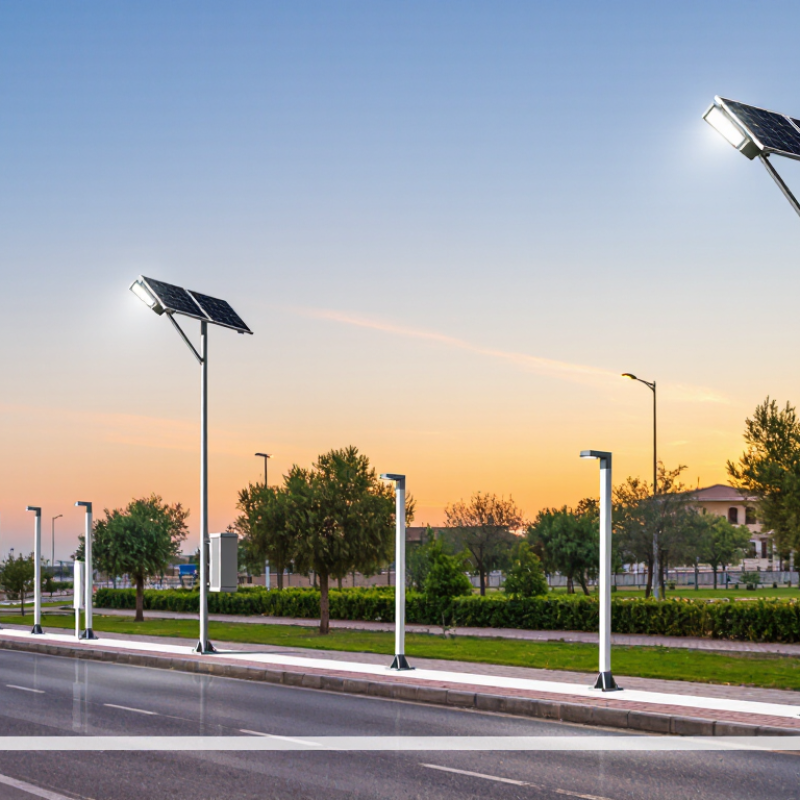
Solar pole lights combine a photovoltaic panel, battery, LED module, controller, and supporting pole. Each part affects nighttime performance. The PV panel converts sunlight into electrical energy during the day. Its angle, surface cleanliness, and daily shade exposure matter greatly. A small shadow from a nearby tree can reduce charging more than expected.
The battery stores energy for evening operation and cloudy periods. Capacity should match the required lighting hours, local sunlight, and seasonal weather. Lithium-based batteries usually offer compact storage and stable cycling. However, cold temperatures can reduce charging efficiency. The controller manages charging, discharge protection, and automatic lighting schedules. A reliable controller helps prevent deep discharge and unnecessary battery stress. LEDs provide efficient illumination, but wattage alone does not show real performance. Check lumen output, beam distribution, color temperature, and glare control. The pole must resist wind, moisture, corrosion, and repeated mechanical loading. Poor installation can weaken even a well-designed system.
Tips: Inspect the site at night before choosing lumen levels. Measure winter sunlight, not only summer sunlight. Leave practical access for battery replacement and cleaning. Waterproof ratings are useful, but seals can still age. No design is perfect. Buyers should review test reports, warranty terms, operating temperatures, and maintenance instructions. One overlooked detail can create a costly lighting gap.
Sizing Output with 4–6 Peak Sun Hours and 100–200 lm/W LED Efficacy
Top Solar Pole Lights Outdoor for Global Buyers
Sizing output begins with two practical inputs: peak sun hours and LED efficacy. The World Bank’s Global Solar Atlas shows many regions receiving roughly 4–6 peak sun hours daily, but winter values can fall sharply. The U.S. Department of Energy reports that efficient outdoor LEDs commonly reach 100–200 lm/W. A 10,000-lumen fixture at 150 lm/W therefore needs about 67 watts. Running it for eight hours consumes approximately 536 Wh nightly.
Panel sizing must include real losses. Using five peak sun hours and an 80% overall derating factor, a 536 Wh load needs about 134 W of photovoltaic capacity. Batteries need more care. For two cloudy nights, storage should exceed 1,340 Wh before temperature and aging allowances. NREL’s PVWatts documentation uses a 14% default system-loss assumption for many grid-connected estimates. Stand-alone lighting usually needs a more cautious calculation because controllers, batteries, dust, and shading add losses. These figures are useful, not perfect.
Tips: Check monthly solar data, not only annual averages. Measure pole shadows at winter noon. Ask for tested lumen output, not LED chip ratings. Keep a 20–30% sizing margin where snow, dust, or heat is expected. A common mistake is choosing a brighter lamp without checking battery recovery. I have seen technically attractive designs fail after several cloudy evenings; the lesson is uncomfortable but clear: output claims need local validation.
Top Solar Pole Lights Outdoor for Global Buyers
PV sizing for a 4,000 lm light output, 12-hour nightly operation, 4–6 peak sun hours, and 100–200 lm/W LED efficacy.
Estimated PV capacity is calculated as: required LED power × 12 operating hours ÷ (peak sun hours × 80% system efficiency). Higher LED efficacy reduces the required LED wattage and solar panel size for the same lumen target.
Battery Design for 2–5 Nights of Autonomy Using LiFePO4 Technology
Top Solar Pole Lights Outdoor for Global Buyers
Battery Design for 2–5 Nights of Autonomy Using LiFePO4 Technology
Reliable solar pole lights begin with honest energy calculations. A 12-watt lamp running for 10 hours consumes 120 watt-hours nightly. Five nights require about 600 watt-hours before system losses. Allowing 15% conversion loss and 20% aging reserve, the battery should store roughly 880 watt-hours. This estimate changes with dimming schedules, temperature, and actual nighttime hours.
LiFePO4 technology suits outdoor lighting because it offers strong thermal stability and long cycle potential. BloombergNEF reported an average lithium-ion battery pack price of 115 US dollars per kWh in 2024, while LFP chemistry generally supports lower material costs. In field installations, a battery management system remains essential. It protects against overcharge, deep discharge, and abnormal temperature conditions. Cold nights matter.
The International Energy Agency reported that solar PV remained the fastest-growing renewable electricity source in 2023. That growth does not guarantee perfect lighting every night. Cloudy weather can reduce charging sharply. A five-night specification should therefore identify test conditions, panel size, lamp output, and usable battery capacity. Some products advertise nominal capacity only. That is not enough. Buyers should request measured autonomy at the rated lumen output, not at an emergency dimming level. I would also inspect drainage, cable sealing, and battery replacement access. Small installation details often decide long-term reliability.
Global Safety Standards: IEC 60598, EN 13201, CE, RoHS, and UL
Top solar pole lights for outdoor projects must satisfy more than brightness claims. IEC 60598 provides essential safety requirements for luminaires, including insulation, wiring, heat resistance, and mechanical protection. Buyers should request test reports matching the actual pole light model, not a similar product.
EN 13201 helps assess road lighting performance, such as uniformity, glare, and maintained illumination. It is especially useful for streets, pathways, and public parking areas. However, the standard does not automatically confirm suitability for every site. Pole height, spacing, weather, and traffic conditions still require professional review.
CE indicates conformity with applicable European requirements, while RoHS limits certain hazardous substances in electrical equipment. UL certification is often expected for North American projects and focuses on recognized safety requirements. These marks are not interchangeable. A CE declaration cannot replace UL evaluation, and a laboratory report may not equal certification. Buyers should also check IP and IK ratings, battery safety, charging performance, and photometric files. I have seen projects delayed because documents covered only the controller, not the complete fixture. That mistake is easy to make. Reliable purchasing needs traceable reports, current declarations, and clear installation limits. Even experienced teams should recheck local rules before approving large quantities.
Buyer Selection Metrics: 10–100 W, 3000–6500 K, and 5–12 m Pole Heights
Selecting solar pole lights for global projects requires more than comparing wattage.
A 10–30 W fixture can suit pathways and small courtyards, while 50–100 W models better serve roads, parking areas, and wide public spaces. Check delivered lumens, not wattage alone. Two fixtures with equal power may produce very different illumination.
Color temperature changes the site’s appearance.
Choose 3000–4000 K for residential paths, where warmer light feels less harsh. Use 5000–6500 K when visibility and clearer contrast matter, such as loading zones or larger roads. However, very cool light can create glare.
I once treated higher Kelvin as automatically better. That was a poor assumption.
Pole height affects spacing, brightness, and maintenance access.
A 5–7 m pole often works for walkways and compact streets. Heights from 8–12 m can cover broader areas, but they demand stronger foundations and careful wind-load assessment. Confirm local engineering requirements before installation. Solar exposure also matters. A 100 W light may perform poorly if its panel receives afternoon shade or seasonal snow.
Review battery capacity, operating hours, charging performance, and protection ratings together.
Ask for test data under low-temperature and cloudy conditions, not only ideal laboratory results. Motion dimming can extend overnight operation, but it may not suit every public area.
A practical trial installation reveals dark zones, glare, and unexpected shadows before a full purchase. Small errors become expensive at scale.