Solar Post Lights can define the look of a garden path, driveway, or courtyard after sunset. Yet appearance is only part of the buying decision. Buyers also need to understand how a product performs in changing weather, where its components come from, and how reliably a supplier can fulfill an order. China has a broad network of lighting manufacturers and trading suppliers, but their capabilities vary considerably.
This guide explores how to identify suitable Chinese suppliers for different projects, from compact residential fixtures to larger landscaping orders. It considers practical details such as materials, battery capacity, solar panel output, brightness, installation dimensions, customization options, sample availability, and warranty terms. Ask for current product specifications and relevant test documentation, then compare those details against the conditions where the lights will be installed. A sunny product photo tells you very little about winter performance.
A polished catalog is not proof of consistent production. Request samples where possible, inspect the finish and assembly, and clarify how defects or delayed shipments are handled. Small details matter. A loose cap or unclear installation guide can create problems across an entire order. Supplier information and product ranges can also change, so confirm key claims directly before making a commitment. No checklist removes every sourcing risk, and not every project needs the most feature-rich option. The aim is to make a careful, informed choice that fits the site, budget, and expected service life.
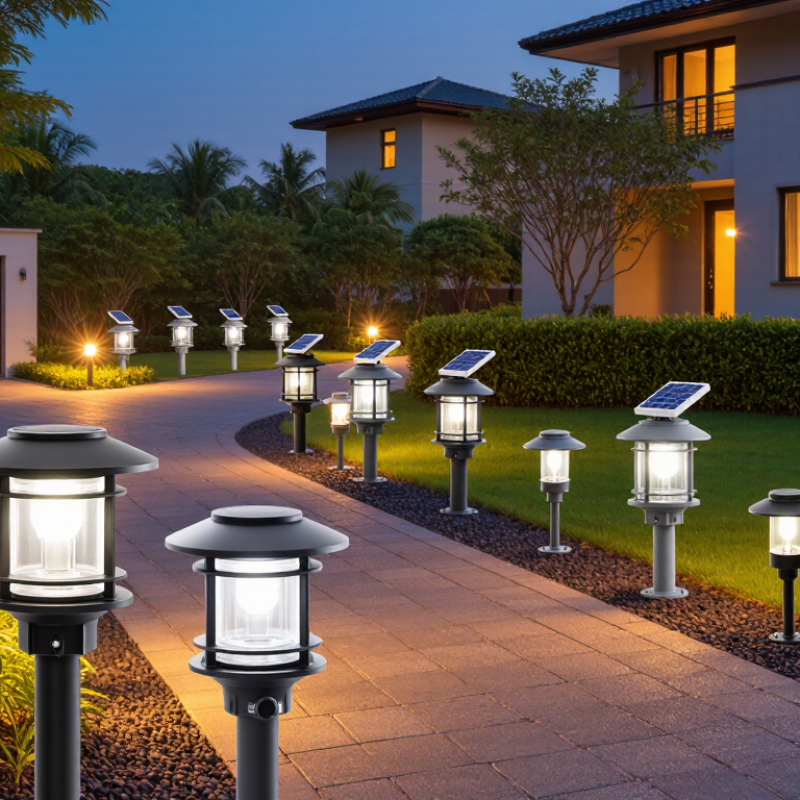
Solar post lights combine a photovoltaic panel, rechargeable battery, charge controller, LED engine, and weather-resistant housing. The panel collects daytime sunlight; the controller manages charging and switches illumination on after dusk. A well-designed fixture also directs light downward, reducing glare on paths and entrances. Small details matter: a shaded panel or poorly sealed cable entry can shorten reliable operation.
The market context is expanding, though it does not measure post-light sales directly. IRENA’s Renewable Capacity Statistics 2024 reports that global solar capacity grew by 345.5 GW in 2023, reaching 1,419 GW. That growth supports wider access to solar components, but buyers still need to check battery capacity, panel output, and winter operating hours. Real sites are messier than product sheets suggest. A tall hedge can cast afternoon shade, while cold weather may reduce battery performance. For gardens, parking edges, and remote walkways, match light distribution and runtime to the actual layout—not just the stated lumen figure.
Testing on site is useful. And easy to overlook.
Solar post lights collect daylight through photovoltaic cells mounted on the fixture or cap. These cells convert sunlight into direct-current electricity. A small controller then directs that energy into a rechargeable battery. At dusk, a light sensor usually switches on the LEDs, which draw power from the stored charge. A simple chain. Each part matters.
On a clear afternoon, a post beside an open garden path may receive several hours of direct sun. Deep shade, dust on the panel, or a north-facing position can reduce charging. Cloudy weather also changes the result. The light may shine for fewer hours, or appear dimmer near dawn. Battery capacity, panel size, LED output, and sensor settings all affect performance, so advertised runtimes are not guarantees. That detail is easy to overlook.
For dependable use, check the panel’s exposure across the day, not just at noon. Wipe away leaves and grit when needed, and allow for seasonal changes in daylight. In my experience, placement can matter as much as fixture design. Yet no installation is perfect; nearby trees grow, and winter sun sits lower. A practical choice balances brightness with realistic charging conditions.
China’s solar post light supply landscape brings several production stages close together. In many manufacturing areas, suppliers can coordinate aluminum or steel housings, LED boards, photovoltaic panels, batteries, and packaging. This can shorten development cycles, especially for buyers requesting different post heights, finishes, or mounting dimensions. Yet a broad supplier network does not guarantee consistent quality. Specifications matter.
A reliable evaluation starts with the product’s operating details. Ask for panel output, battery capacity, LED power, and stated runtime, then check how those figures were measured. Review samples for water ingress, corrosion protection, wiring quality, and stable performance after repeated charging. For outdoor projects, test lights in realistic conditions: shaded paths and winter days can expose weaknesses that a bright showroom hides. Small details count.
Manufacturers may offer custom tooling and flexible order quantities, but changes can affect lead time and inspection needs. Confirm component substitutions in writing, and request production samples before approving a larger shipment. A factory report is useful, though it cannot replace independent checks. No test predicts every site condition. Buyers should compare service terms, spare-part availability, and packaging protection alongside price. The landscape is capable and varied, but careful verification remains essential.
Leading Solar Post Light Manufacturers and Suppliers in China
China’s solar post light manufacturers and suppliers offer options for gardens, pathways, driveways, and fence posts. Manufacturers may handle housing design, solar panel selection, battery integration, and production. Suppliers can help compare specifications and coordinate samples. Ask for clear product sheets showing lumen output, battery capacity, panel rating, and operating time. A light that looks bright in a showroom may perform differently after several cloudy days.
Tips: Request a sample and test it outdoors for at least a week. Check whether the light switches on reliably at dusk, and inspect the panel, seals, and mounting hardware. Confirm the stated IP rating and ask how performance changes in cold or shaded conditions. Small details matter.
When evaluating suppliers, discuss minimum order quantities, customization, packaging, lead times, and warranty terms in writing. Ask how quality checks are conducted, including battery and charging tests. Compare like-for-like specifications rather than relying on appearance or price alone. No specification sheet answers everything; that is easy to forget. A sample test may reveal uneven brightness or a loose fitting, so leave time for adjustments before placing a larger order.
China’s solar post light market offers broad choices, but product labels rarely tell the whole story. IEA PVPS reported 456 GW of new solar PV capacity worldwide in 2023, in Trends in Photovoltaic Applications 2024. That growth signals a mature supply chain, not uniform product quality. Small details matter.
When evaluating suppliers, request a complete bill of materials and test reports for the exact model. Check panel wattage, battery chemistry and capacity, measured light output, and runtime after several cloudy days. Ask how ingress protection and corrosion resistance were tested, especially for coastal installations. IRENA’s Renewable Power Generation Costs in 2023 reported a 12% year-on-year decline in utility-scale solar PV costs. That figure describes large systems, not post lights, but it highlights why price alone is a poor quality signal. Compare quotations against verified components and warranty terms.
Order samples before committing to volume. Test them outdoors through changing weather, and record operating hours after dusk. A spreadsheet cannot reveal every weak seal or inconsistent finish. It may miss one. Confirm production lead times, inspection procedures, spare-part availability, and how battery replacements are handled. Keep the approved sample as a reference, because small changes between batches can affect performance.
| Evaluation dimension | What to check | Evidence to request | Practical evaluation method |
|---|---|---|---|
| Product configuration | Post-top or pier-mount design, dimensions, mounting interface, finish, and intended installation location. | Dimensioned drawings, installation instructions, material and finish specifications, and product photographs. | Compare the drawings with the post or pillar dimensions at the project site; confirm the mounting method before ordering samples. |
| Light output and distribution | LED power, reported luminous flux, color temperature, beam or distribution pattern, and brightness-control modes. | Photometric report or test data, LED specification, and a clear description of operating modes. | Compare products under the same operating mode and test conditions. Do not treat LED wattage alone as a measure of useful light output. |
| Solar panel and charging | Panel type, rated power, charging control, panel orientation, and whether the panel is integrated or separate. | Panel datasheet, charging-system description, and test conditions used for charging and runtime claims. | Assess local sunlight, seasonal conditions, shading, and panel orientation. Request performance information for the intended installation conditions. |
| Battery and runtime | Battery chemistry, rated capacity, replaceability, protection features, and runtime at each brightness setting. | Battery datasheet, protection details, runtime test report, and replacement instructions where applicable. | Check how runtime was measured, including charge level, light mode, and test environment. Confirm battery availability and replacement options. |
| Weather and corrosion resistance | Ingress-protection rating, sealing design, corrosion resistance, drainage, and suitability for the project climate. | Test report supporting the stated IP rating, construction details, and material or coating specifications. | Verify the rating against IEC 60529 terminology and the actual installation requirements. Confirm that the report applies to the offered model. |
| Materials and build quality | Housing material, lens material, fasteners, surface treatment, UV exposure considerations, and finish consistency. | Bill of materials, material declarations, finish samples, and quality-control inspection records. | Inspect samples for fit, finish, sharp edges, loose components, and visible sealing defects; compare samples with the final approved specification. |
| Compliance for destination market | Applicable electrical, battery, chemical, labeling, and import requirements for the target country or region. | Relevant declarations, test reports, labels, and supporting documents for the exact product configuration. | Confirm requirements with the importer or a qualified compliance specialist. Check document scope, model numbers, and issuing laboratory details. |
| Quality assurance | Incoming-material checks, production inspections, functional testing, final inspection, and defect-handling process. | Quality-control plan, sample inspection records, test checklist, and corrective-action process. | Agree on measurable acceptance criteria before production and consider a pre-shipment inspection against the approved sample and purchase specification. |
| Supplier capability | Whether the supplier manufactures the product or trades it, production processes, subcontracting, and communication responsiveness. | Business and factory details, production-process overview, relevant product references, and permission for an audit or video inspection. | Cross-check business details and product knowledge; ask who controls design changes, component sourcing, and final quality approval. |
| Samples and customization | Sample availability, tooling requirements, custom finishes, packaging changes, and approval process. | Sample quotation, customization specification, sample lead time, and written confirmation of approved changes. | Test a production-representative sample and retain an approved reference sample before authorizing mass production. |
| Commercial terms | Minimum order quantity, unit-price basis, payment schedule, production lead time, quotation validity, and shipping terms. | Itemized quotation, pro forma invoice, production schedule, and clearly stated Incoterms® rule and named place. | Compare quotations on the same specification, quantity, packaging, and delivery basis; clarify charges that are excluded from the unit price. |
| Packaging and logistics | Individual and outer-carton protection, carton dimensions, product labeling, battery shipping documentation, and export packing. | Packaging specification, carton measurements, shipping marks, and applicable battery transport documents. | Review packaging for the selected transport method and ask the freight forwarder to confirm current requirements for the battery configuration. |
| Warranty and after-sales support | Warranty duration and scope, exclusions, claim procedure, spare parts, and responsibility for replacement or repair costs. | Written warranty terms, defect-claim process, spare-parts list, and expected response procedure. | Ensure warranty terms are included in the sales contract and define how defects, evidence, replacement products, and freight costs will be handled. |
Note: Product specifications, order terms, test requirements, and compliance obligations vary by model, supplier, and destination market. Verify all claims against current documents for the exact product being purchased.